-
 play_arrow
OTR Radio Discover What's Next
-
 play_arrow
Beat Breakdown Mia Johnson

Your Song Is Everywhere. So Where’s the Money?
A plain-English guide to music royalties for independent artists who would rather make music than earn a degree in music publishing.
Congratulations.
You finished your song.
You uploaded it through a distributor.
It’s on Spotify.
It’s on Apple Music.
It’s on YouTube Music.
Somebody used it in a video.
Maybe it even played on internet radio.
Money is being generated.
Excellent.
So…
Where the hell is it?
Welcome to music royalties.
This is the part of the music business where perfectly intelligent people start hearing phrases like mechanical royalty, public performance, neighboring rights and publishing administration and suddenly decide maybe exposure isn’t so bad after all.
It doesn’t need to be that complicated.
So we’re going to try something dangerous.
We’re going to explain music royalties in plain English.
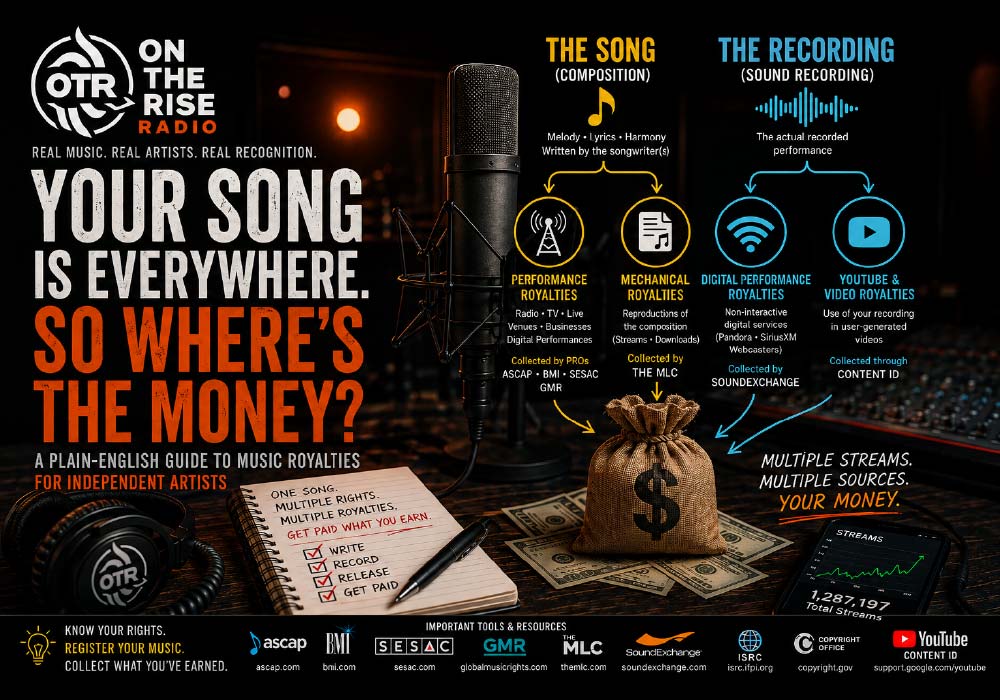
First: Your Song Is Actually Two Things
This is the most important concept in this entire article.
When you make a record, the music business generally sees two separate pieces of property.
1. The Song
The melody.
The music.
The lyrics.
The composition itself.
2. The Recording
The actual recorded performance people hear on Spotify, Apple Music, YouTube, radio, etc.
Those are not the same copyright.
Here’s the easiest example.
Dolly Parton wrote “I Will Always Love You.”
Whitney Houston later recorded her famous version.
The song and Whitney’s recording of the song are two different things.
Different rights.
Potentially different owners.
Different royalties.
The U.S. Copyright Office treats musical works and sound recordings as separate works for exactly this reason.
If you write, perform, produce and release your own music independently, you may control both sides.
Which is great.
It also means you need to understand both sides.
Your Distributor Handles One Important Piece
Let’s say you use a distributor to put your music on Spotify, Apple Music and other streaming platforms.
When somebody streams your recording, the streaming service pays money associated with the master recording to the appropriate rights holder through the distribution chain.
If you’re completely independent and own your masters, that may ultimately be you, minus whatever fees or percentage your distributor takes under your agreement.
Great.
You’re getting paid.
Case closed.
Right?
Not even close.
Because your distributor collecting money connected to your recording does not necessarily mean every royalty connected to the song underneath that recording is being collected for you.
That’s where independent artists get into trouble.
They think:
“My distributor handles my royalties.”
Maybe some of them.
Maybe even a lot of them.
But you need to know exactly what your distributor collects under your particular agreement.
Never assume.
Meet the PRO
PRO stands for Performing Rights Organization.
Don’t let the name scare you.
Think of a PRO as an organization that helps songwriters and publishers get paid when their compositions are publicly performed.
That can include radio.
Television.
Live venues.
Businesses.
And certain digital uses.
In the United States, organizations operating in this space include ASCAP, BMI, SESAC and Global Music Rights.
If you wrote your songs, this matters to you.
Your PRO keeps track of eligible performances and distributes royalties according to its system and your registration information.
But here’s the important part:
You need to properly register your songs.
Joining an organization and then never registering your music is a little like opening a bank account and forgetting to tell your employer where to send your paycheck.
Not ideal.
Then There Are Mechanical Royalties
Here comes one of those music-business terms that sounds much more complicated than it is.
A mechanical royalty is associated with reproductions of the composition.
The name comes from the days when music was physically reproduced through mechanical means.
Think records.
Later CDs.
Downloads.
The name stuck.
Today, interactive streaming services such as Spotify and Apple Music also generate mechanical royalties on the songwriting/composition side.
In the United States, an organization called The Mechanical Licensing Collective — The MLC — administers blanket mechanical licenses for eligible streaming and download services and distributes those royalties to eligible songwriters, composers, lyricists, publishers and administrators.
If you’re an independent songwriter who administers your own music, this is something you should understand.
Because again:
Your distributor depositing money into your account does not automatically mean you’ve collected every mechanical royalty your composition earned.
The MLC says membership is free for eligible rightsholders, and self-administered songwriters can register their works and collect qualifying U.S. digital mechanical royalties directly.
That deserves your attention.
And Then There’s SoundExchange
Different bucket.
SoundExchange collects certain digital performance royalties for sound recordings in the United States.
Notice we said sound recording.
Not songwriting royalties.
SoundExchange covers eligible non-interactive digital services such as SiriusXM, Pandora’s qualifying radio-style services and webcasters.
If you’re a featured recording artist or you own your sound recording, you may have money coming through SoundExchange.
If you’re both?
You may qualify on both sides of that particular royalty.
SoundExchange says registration is free.
And yes, people really do discover money sitting there waiting for them.
It’s worth checking.
One important distinction:
SoundExchange is not the organization collecting your songwriter/publisher royalties.
Different rights.
Different bucket.
Remember our two sides?
The song.
The recording.
We’re going to keep coming back to those.
What About YouTube?
YouTube adds another interesting layer.
Someone uploads a video using your recording.
You didn’t upload the video.
Your music is still in it.
That’s where Content ID can come into play.
YouTube’s Content ID system compares uploaded videos against reference material supplied by eligible copyright owners and rights-management partners.
When it finds a match, the rights holder can potentially track the use, block it or monetize it depending on the circumstances and applicable rights.
Independent artists commonly access Content ID through distributors or rights-management companies rather than directly through YouTube.
But don’t blindly check the “YouTube Content ID” box on everything you’ve ever made.
You need to control the appropriate exclusive rights.
If your recording contains material you only licensed non-exclusively—certain beats, loops or other material, for example—you need to understand whether the track is actually eligible.
Incorrect Content ID claims can create a mess.
Again:
Know what you own.
Okay… What the Hell Is an ISRC?
This one is easier.
ISRC stands for International Standard Recording Code.
Think of it as a permanent identification number for a specific recording.
Not the song.
The recording.
If you record a studio version of a song, that recording gets an ISRC.
If you later make a genuinely different recording or version that requires its own identifier, it can receive another ISRC.
The ISRC helps streaming services, distributors, broadcasters, rights organizations and other music-industry systems identify the correct recording.
And here’s something important:
An ISRC doesn’t prove copyright ownership.
It identifies the recording.
That’s it.
Your distributor will often assign ISRCs when you release music, or qualifying recording owners can obtain or assign them through the official ISRC system.
Once an ISRC has been assigned to a recording, don’t create another one just because you switch distributors.
The recording keeps its existing ISRC.
That’s how its history stays attached to the correct recording.
Let’s Follow One Independent Artist
Meet Maya.
Maya writes a song.
She records the vocals.
She produces the record.
She owns everything.
Then she releases it.
Someone streams Maya’s song on Spotify.
There may be money associated with the master recording.
There may also be royalties associated with the composition she wrote.
Somebody hears Maya on an eligible non-interactive digital radio service.
That may create another royalty stream involving the sound recording.
Somebody uses her recording in a YouTube video.
That may create another opportunity for monetization if the recording is properly represented through Content ID and eligible for it.
Maya doesn’t have four different songs.
She has one song creating money through different rights.
That’s the part people miss.
Music royalties aren’t one paycheck.
They’re a collection of different revenue streams generated by different rights and often collected by different organizations.
Here’s the Beginner Version
If you’re an independent U.S. artist releasing original music, start by asking yourself:
Did I write the song?
If yes, understand the songwriter/composition side.
Do I own the recording?
If yes, understand the master side.
Is my music registered with my PRO?
If you’re a songwriter, it probably needs to be on your radar.
Am I self-administered, and do I understand The MLC?
If you’re entitled to U.S. digital mechanical royalties, find out.
Am I a featured performer or sound-recording owner?
Look at SoundExchange.
Does my distributor offer YouTube Content ID?
Understand exactly what it does and whether your recordings qualify.
Do my recordings have ISRCs?
Know them.
Keep them.
Don’t lose your metadata.
That’s already enough to put you ahead of a surprising number of people releasing music.
Your Metadata Is Not Boring
Okay.
It is boring.
But it’s important.
Artist name.
Song title.
Songwriters.
Publishers.
Ownership percentages.
ISRC.
Release information.
Collaborator splits.
Keep accurate records.
If you write a song with another person, agree on the splits before the song starts making money.
Not three years later when everybody suddenly remembers the studio session differently.
“I wrote most of the chorus.”
“No you didn’t.”
“That melody was mine.”
“You weren’t even there Tuesday.”
Congratulations.
You now have a music-industry documentary.
Get the splits in writing.
Don’t Register Everywhere Just Because You Read This Article
This is also important.
Your situation may be different depending on whether you’re a songwriter, performer, producer, label, publisher, self-administered artist or signed artist.
You may already have a publisher or publishing administrator collecting some of these royalties.
Your distributor may provide additional collection services.
Your label agreement may control certain rights.
And if you’re outside the United States, different collection societies and rules may apply.
The answer isn’t:
SIGN UP FOR EVERYTHING!
The answer is:
Know what you own. Know who’s collecting it. Know what they aren’t collecting.
That’s the game.
Useful Places to Start
If you’re releasing music independently in the United States, these are worth bookmarking:
ASCAP — Performing-rights organization for songwriters, composers and publishers.
BMI — Performing-rights organization representing songwriters, composers and publishers.
SESAC — U.S. performing-rights organization; affiliation is selective.
Global Music Rights (GMR) — Performing-rights organization representing songwriters and publishers.
The MLC — U.S. digital mechanical royalties for eligible musical works.
SoundExchange — Digital performance royalties for eligible sound recordings on non-interactive services.
International ISRC Agency / IFPI — Official information about ISRCs and how recordings are identified.
U.S. Copyright Office — Official information and registration for copyrights in musical works and sound recordings.
YouTube Content ID — Information about YouTube’s rights-management system and eligibility.
Don’t spend $500 with some random website promising to “register your music with the entire music industry.”
Go to the organizations themselves first.
Read.
Learn.
Then decide what applies to you.
The Music Business Part of Making Music
Nobody starts writing songs because they’re excited about metadata.
Nobody picks up a guitar because they can’t wait to learn about mechanical royalties.
And absolutely nobody has ever walked into a studio and said:
“Man, I can’t wait to register this composition.”
But if you’re going to treat your music like a business, eventually you have to handle the business part.
The good news?
You don’t need to understand every corner of music publishing before releasing your first record.
Start with the basics.
There is a song.
There is a recording of that song.
Different rights can generate different money.
Different organizations may collect that money.
And nobody cares about getting you paid quite as much as you do.
Make the record.
Release the record.
Promote the hell out of the record.
Just make sure that when the record earns something…
the money knows how to find you.
Similar posts

HOT NOW
Chart
-

1
play_arrowMegaphone
-

2
play_arrowGrounded
-
3
play_arrowMoney
-

4
play_arrowSpitting Image
-

5
play_arrowRise Again
-